GUSTA case study — ENE2ESE
ENE2ESE: ongoing support and an e-commerce chatbot
A conversational layer integrated into the store helps customers navigate a specialized catalog while ongoing work keeps support and the digital experience connected.
- Industry
- Gemstones and e-commerce
- Platform
- VTEX
- Stage
- Scale, operate and evolve
The operational context
ENE2ESE works with a gemstone catalog where a purchase often begins with a question. A customer may be looking for a specific gem, comparing cuts, trying to understand characteristics, considering a professional application, or asking about an order, delivery, payment or exchange. In this kind of journey, conventional search does not always express intent clearly. Customer service has to connect the shopper's language with the actual organization of the catalog without pretending that every question can be solved automatically.
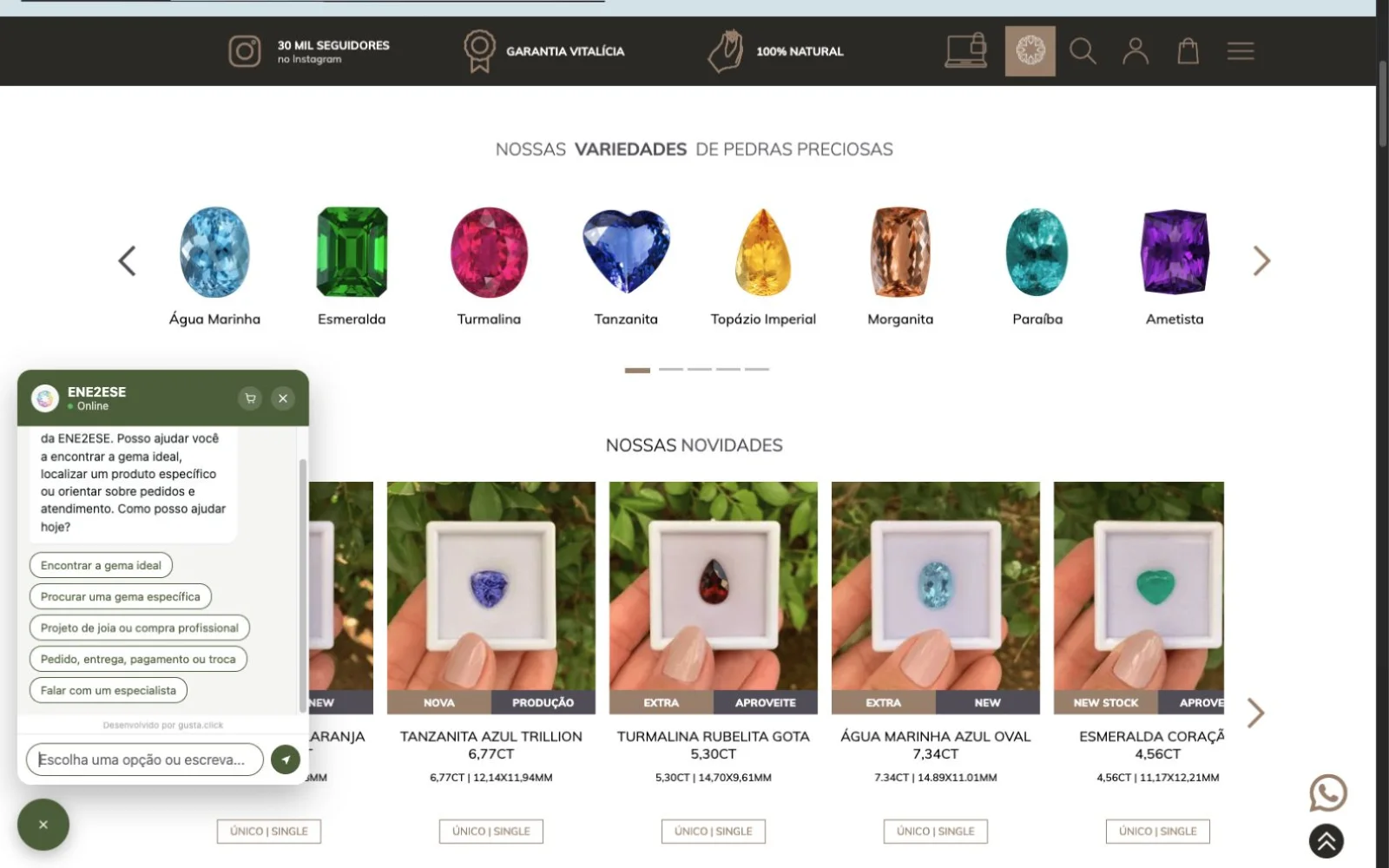
GUSTA's work combines ongoing support for the e-commerce experience with a chatbot integrated into the store journey. The conversational layer was structured to welcome visitors with clear paths, accept open questions and keep access to a specialist available. Its role is to guide and organize the interaction while preserving human responsibility for situations that require commercial, technical or contextual judgment.
A chatbot connected to the shopping journey
The chatbot offers starting points around common contact reasons: finding the right gem, locating a specific product, discussing a jewelry project or professional purchase, handling order questions and talking to a specialist. These paths are not a closed menu. They reduce ambiguity and help each conversation reach the next step with better context.
Rather than answering outside the reality of the store, the experience is grounded in the catalog and the authorized support scope. When a question depends on availability, negotiation, specialist assessment or a team decision, the conversation should reach a person. This design makes the boundary between automation and human accountability explicit.
Rules, human intervention and visibility
A dependable conversational operation needs clear criteria: which information can be used, which subjects the agent may handle, when it should ask for more detail and when it must hand off. Human intervention is not a chatbot failure; it is part of the architecture. It enables the team to take over, correct an interpretation and handle exceptions without forcing the customer to restart the conversation.
Operational visibility also guides improvement. Real questions can reveal catalog gaps, recurring doubts and stages of the journey that need clearer content. The system can turn those signals into advisory suggestions for product descriptions, FAQ answers and post ideas. People review those suggestions, and nothing is published automatically.
Work that continues after launch
This case is not presented as an isolated pilot. Ongoing support makes it possible to follow changes in the store, customer service needs and new operational learning. Language, conversation paths and integration points can evolve as the team observes real use.
That continuity follows GUSTA's lifecycle: diagnose the problem and design the rules, build and pilot with concrete situations, scale with monitoring and support, and evolve with data. We do not attribute conversion, savings or revenue figures that were not provided. What this case documents is the public and verifiable scope: a live e-commerce operation, an available conversational service layer and ongoing work to keep both experiences aligned.
Need to connect systems, teams and decisions without creating a black box?
Talk to GUSTA ↗