
"It depends" isn't an answer
Anyone who asks how much a website costs almost always hears "it depends". It's true, and it helps nobody close a budget.
We can be more useful than that. Part of the bill has a public list price, and I checked each one on October 7, 2026. The other part is people's work. That part has no price list, but it has a logic, and you can tell what makes the hours double. This article shows both.
One note before the numbers: GUSTA is based in Brazil, so the prices below are the ones shown to visitors in Brazil, some in Brazilian reais (R$) and some in US dollars.
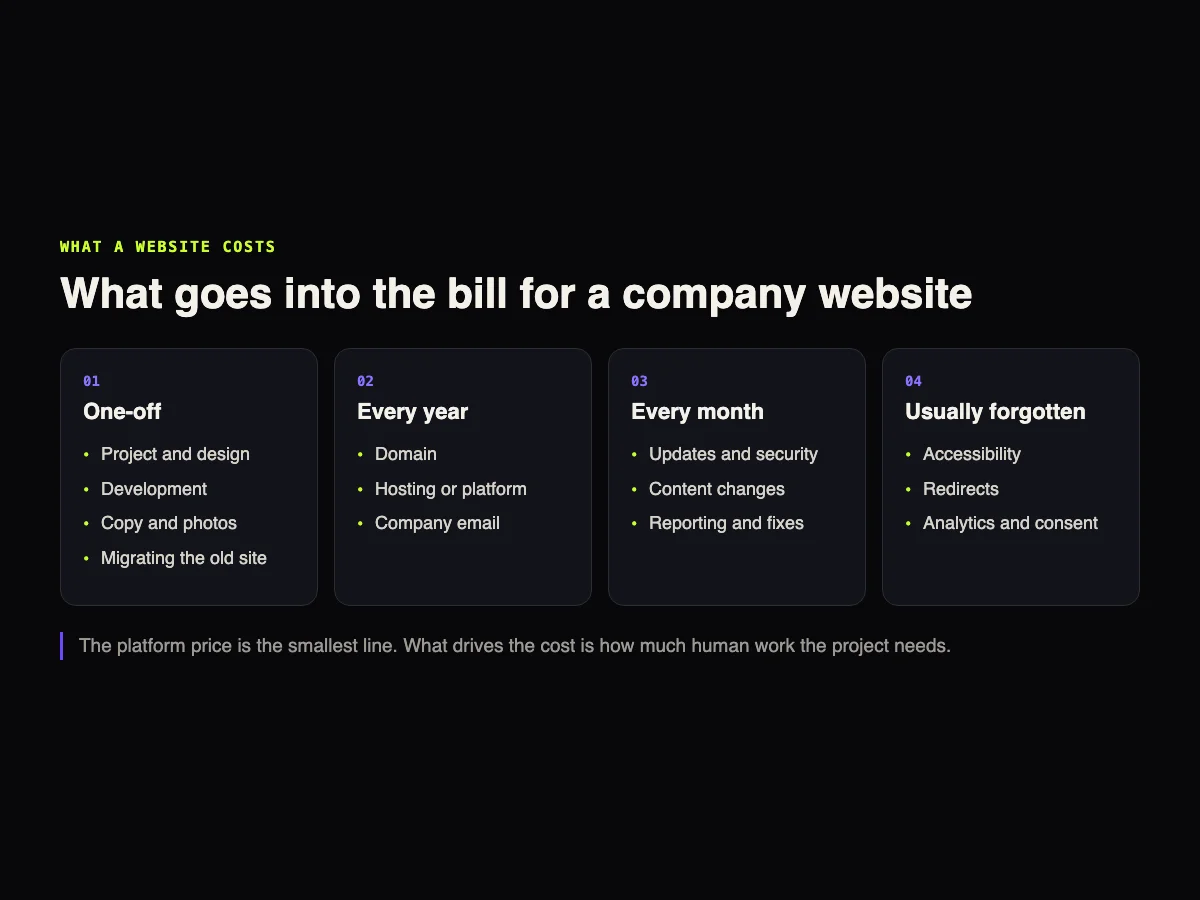
The four lines of the bill
A business website has four kinds of cost. Mixing the four is what makes proposals impossible to compare.
- What you pay once. Planning, design, development, copy, photos and the migration of the old site, if there's one.
- What you pay every year. Domain, hosting or platform, and business email.
- What you pay every month. Updates, security, content changes and fixes.
- What almost always gets left out. Accessibility, redirects, and measurement with consent.
The second line is the easiest to research and the one that weighs least. I'll start there.
What has a list price
The values below are per month on annual billing. On monthly billing, almost everything costs more.
| Where | Plan | Price per month | Note |
|---|---|---|---|
| Wix | Essencial | R$ 16 | Promotional price on the day I checked. R$ 32 without the promotion |
| Wix | Completo | R$ 22 | Promotional price on the day I checked. R$ 44 without the promotion |
| Squarespace | Básico | R$ 39 | R$ 56 on monthly billing |
| Webflow | Basic | US$ 15 | US$ 25 on monthly billing |
| WordPress.com | Premium | US$ 8 | US$ 18 on monthly billing |
| Shopify | Basic | US$ 14 | For online stores. US$ 19 on monthly billing |
| Hostinger | Premium | R$ 10.99 | 48-month contract. Renews at R$ 38.99 |
Outside the platform, there are two fixed bills:
- A .com.br domain: R$ 40.00 per year at Registro.br.
- Business email: Google Workspace Business Starter costs R$ 40.90 per user per month on an annual contract, or R$ 49 with no commitment.
A first-year example
A small company building its own site on a ready-made platform, with one domain and one mailbox:
| Item | Sum | Value for the year |
|---|---|---|
| Platform | Wix Completo, 12 x R$ 22 | R$ 264.00 |
| Domain | .com.br at Registro.br | R$ 40.00 |
| 1 Workspace user, 12 x R$ 40.90 | R$ 490.80 | |
| Total | R$ 794.80 |
Under R$ 800 for the year. Notice that email costs almost twice as much as the site. With five people on the team, email alone goes past R$ 2,400 per year.
Notice the last row of the platform table too. The R$ 10.99 hosting price only exists for those who pay 48 months at once, which comes to R$ 527.52 upfront. On renewal, the same plan goes to R$ 38.99. A shop-window price is a first-contract price. Ask for the renewal price before signing anything.
What has no price list: people's hours
Nobody hires an agency because of the R$ 22 platform fee. What you pay for in a project is the time of whoever plans, designs, writes, codes and tests.
I won't guess a price range here, because a number without a scope is a hunch. What I can show is what moves the number of hours to another level.
| What changes | Why it weighs |
|---|---|
| Page templates | Ten pages with the same design cost little more than one. Ten different designs cost almost ten times as much |
| Who writes the copy | Finished and approved copy shortens the project by weeks |
| Integrations | A form that lands in the CRM, booking, payment, a customer area |
| The old site | Inventory, redirects and follow-up after the cutover |
| Languages | Each language is almost one more site to write and review |
| Online store | Catalog, shipping, payment and invoicing change the size of the project |
When you ask for a quote, describe those six rows. Two proposals for "a corporate website" can arrive with very distant values and both be right, because each supplier pictured a different site. The project steps are in our guide to building a business website.
What almost always gets left out
Three items tend to show up only after the contract is signed, dressed as "extras".
Accessibility. It's a legal requirement for company websites in Brazil, and fixing it later usually costs more than getting it right in the design. The law and the tests are in website accessibility.
Redirects from the old site. Without them, the new site launches losing Google traffic. The full script is in website migration without losing SEO.
Measurement and consent. Analytics set up, conversion events and a cookie notice that lets people decline. Without that, nobody can say whether the site worked.
Ask in writing whether all three are in the price.
After launch, the bill continues
A live site needs updates, backups, monitoring and someone to change the copy when the company changes. On gusta.click, September alone had four fixes nobody had asked for, which only surfaced because someone was looking. Hosting is the smallest line of our cost. Time is the largest.
What goes into that monthly contract, and how to compare proposals, is in website hosting and maintenance. Choosing the server, with prices, is in shared hosting, VPS or cloud.
What the site gives back
Cost alone decides nothing. The other half of the bill is what the site brings in.
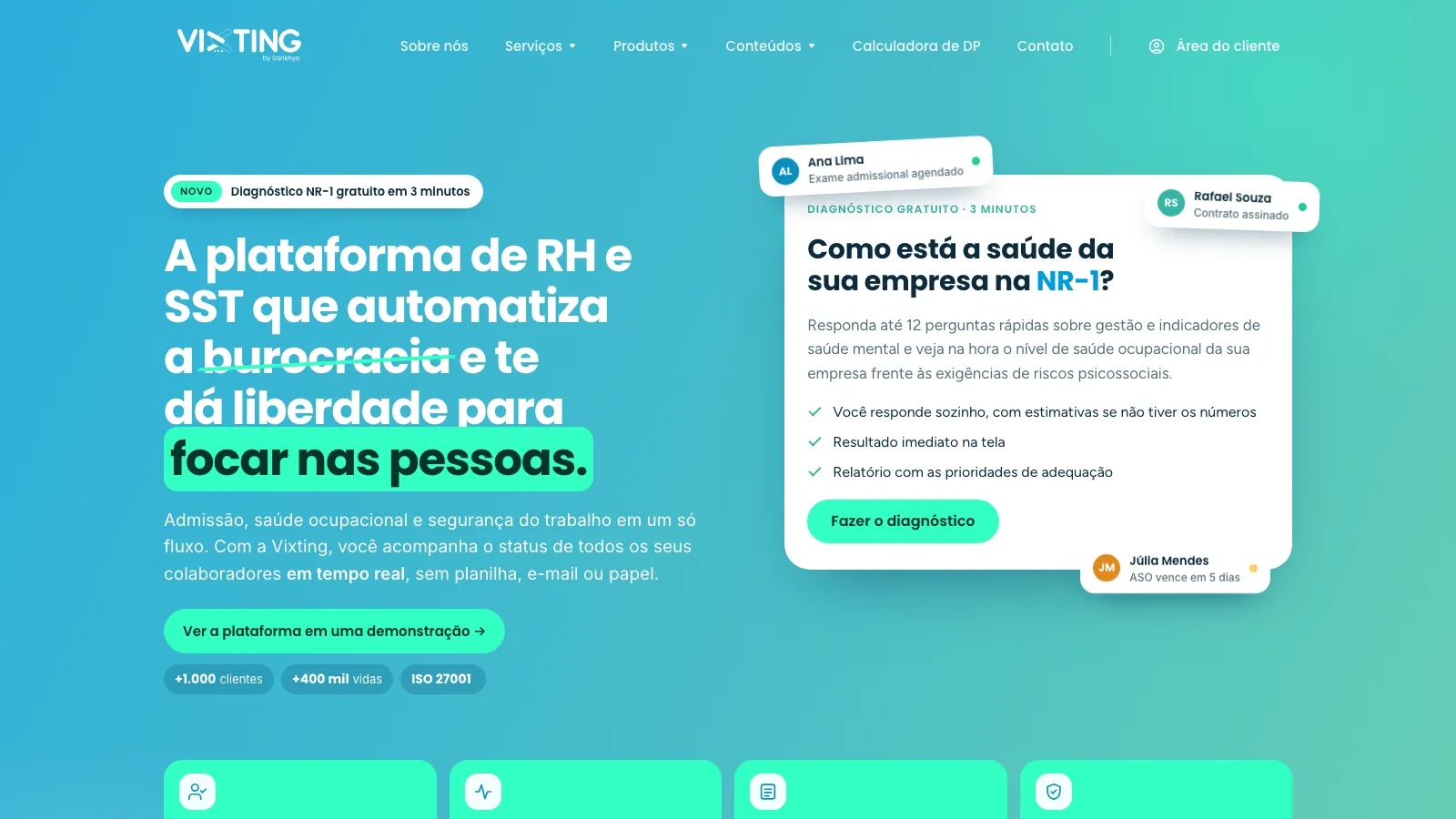
Vixting, an occupational health and digital onboarding company, is an ongoing support client of GUSTA. In Google Analytics I compared July 9 to October 6, 2026 with the same period of 2025:
- sessions grew 47%;
- key events, the actions the company marks as conversions, grew 96%;
- the share of sessions with at least one of those events went from 17.3% to 23.6%.
That result can't be credited to the site alone, nor to us alone. Traffic depends on campaigns, on the brand and on the work of the Vixting team. The point is a different one: the site received far more people and converted a larger share of them. That's the kind of number worth putting next to the cost.
If your company doesn't measure conversions today, start there, before asking for a quote on a new site. Without the before number, there's no after.
How to compare two proposals
- Separate the four lines. Once, every year, every month and what was left out.
- Ask who owns each account. Domain, hosting and platform stay in the company's name.
- Ask for the renewal price. For hosting, the platform and the maintenance contract.
- Check the three forgotten items. Accessibility, redirects and measurement.
- Ask what happens in month 13. Who looks after it, how much it costs and how to leave if it doesn't work out.
Frequently asked questions
Can a company have a website for less than R$ 1,000 per year?
Yes, by building it yourself on a ready-made platform. In the example in this article, platform, domain and one mailbox add up to R$ 794.80 in the first year. What that sum leaves out is your time.
Ready-made platform or custom website?
For a simple corporate site, a ready-made platform usually does the job. Custom starts to pay off when the site has to talk to company systems or follow rules the platform doesn't accept.
Why do two proposals for the same site have such different prices?
Almost always because it isn't the same site. Without a written scope, each supplier pictures a different number of pages, integrations and responsibilities.
Whose name should the domain and hosting be in?
The company's, always. A supplier can manage them, but ownership has to belong to whoever owns the site.
How much does it cost to keep a site running once it's built?
The fixed bills are domain, hosting or platform, and email. The rest is maintenance and content hours, which vary with the volume agreed in the contract.
Sources
Prices checked on the public pages on October 7, 2026, as shown to visitors in Brazil and before taxes: Wix, Squarespace, Webflow, WordPress.com, Shopify, Hostinger, Google Workspace and Registro.br. Prices change and promotions end, so check before you decide.
CTA
Need a quote you can actually compare? Talk to GUSTA and tell us what the site has to do. We send back the scope split into the four lines, with what is in and what is out.
Comments
No comments yet. Be the first to comment.