
An online store that doesn't talk to the stock system sells products that are gone. A store that doesn't talk to the ERP makes someone type orders by hand. And a store nobody looks after once it launches gets old within a few months.
GUSTA, an AI studio based in Brazil, builds online stores with those three things in mind from day one: the store has to sell, it has to be connected to the company's systems, and someone has to look after it once it's live.

What GUSTA does in e-commerce
New stores or redesigns. We build on Shopify, VTEX or WooCommerce, or from scratch when your rules just don't fit a platform. Our article on custom e-commerce with AI helps decide between the two paths.
Integrations. We hook the store up to your ERP, marketplaces, payment and shipping, so stock, prices and orders move without anyone retyping them. Our guide to e-commerce, ERP and marketplace integration covers where this usually breaks.
Custom features. Got a pricing, shipping or catalog rule the platform can't handle out of the box? On WooCommerce, we usually solve that with a custom plugin.
Sales chatbot. Nola AI, a GUSTA product, recommends products from the store's real catalog in the conversation, with price, photo and link.
Support after launch. Fixes, tweaks, campaign pages and new features, done by people who already know your code.
Which platform makes sense
| Platform | When it usually makes sense |
|---|---|
| Shopify | Getting started fast, with a stable store and lots of ready-made apps |
| VTEX | A bigger operation, a large catalog and several sales channels |
| WooCommerce | You already have WordPress or want full control of your own server |
| Custom | Business rules no platform handles without workarounds |
We make that call during the diagnosis, once we've seen your catalog, how many orders you get, what the store has to connect to and who's going to run it every day.
How a project runs
- Diagnosis and scope. Catalog, integrations, what moves over from the current store and what's worth measuring.
- Mobile-first layout. That's where a lot of shopping starts.
- Development and integrations. With test orders before opening to the public.
- Launch. With redirects from the old store and measurement set up. The script for migrating without losing SEO applies to stores too.
- Support and improvement. The store keeps being looked after once it's live.

Stores that are already live
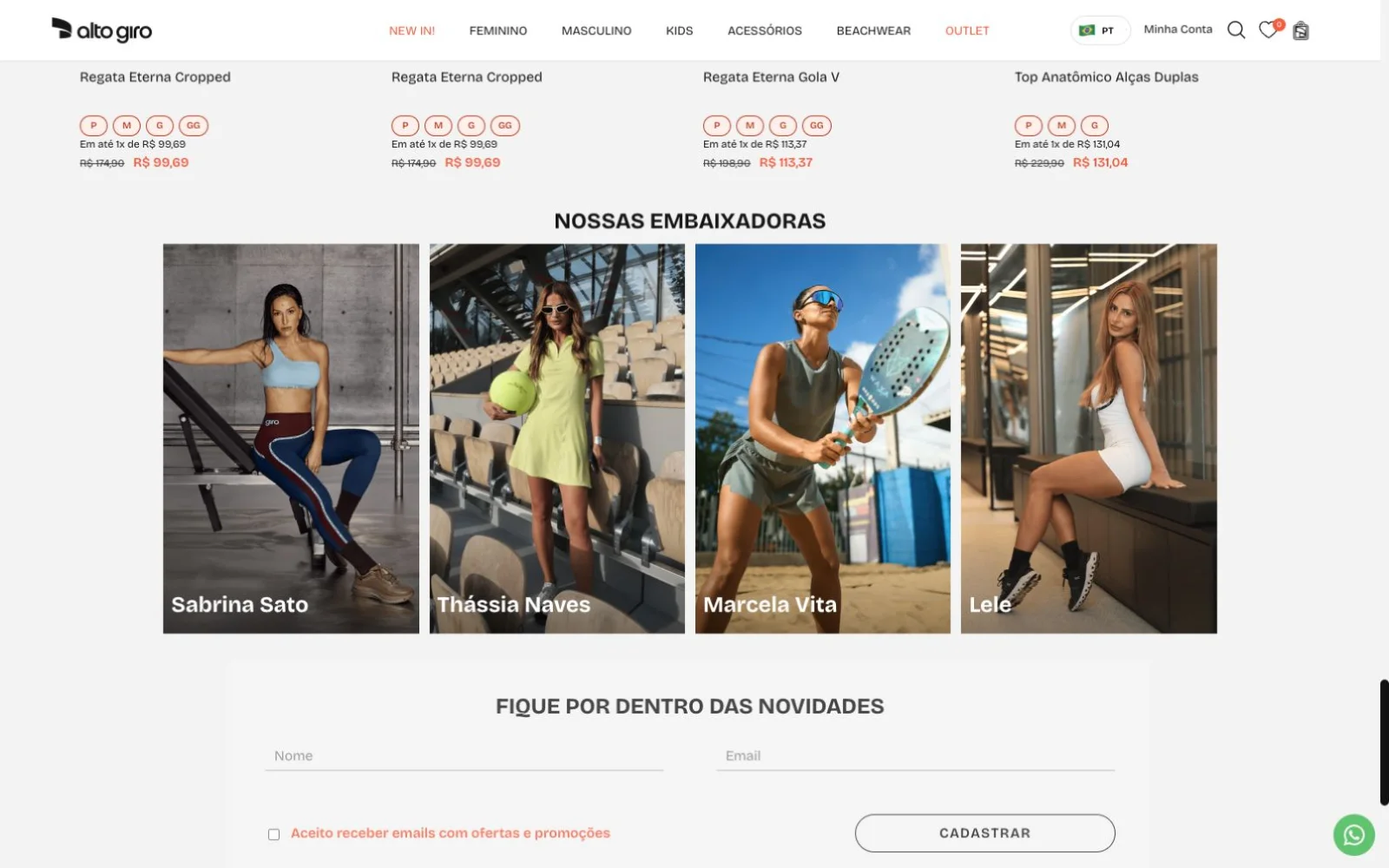
Alto Giro, a fitness fashion brand, had its store developed and implemented by GUSTA on Shopify, focused on a shopping experience that works on any screen.
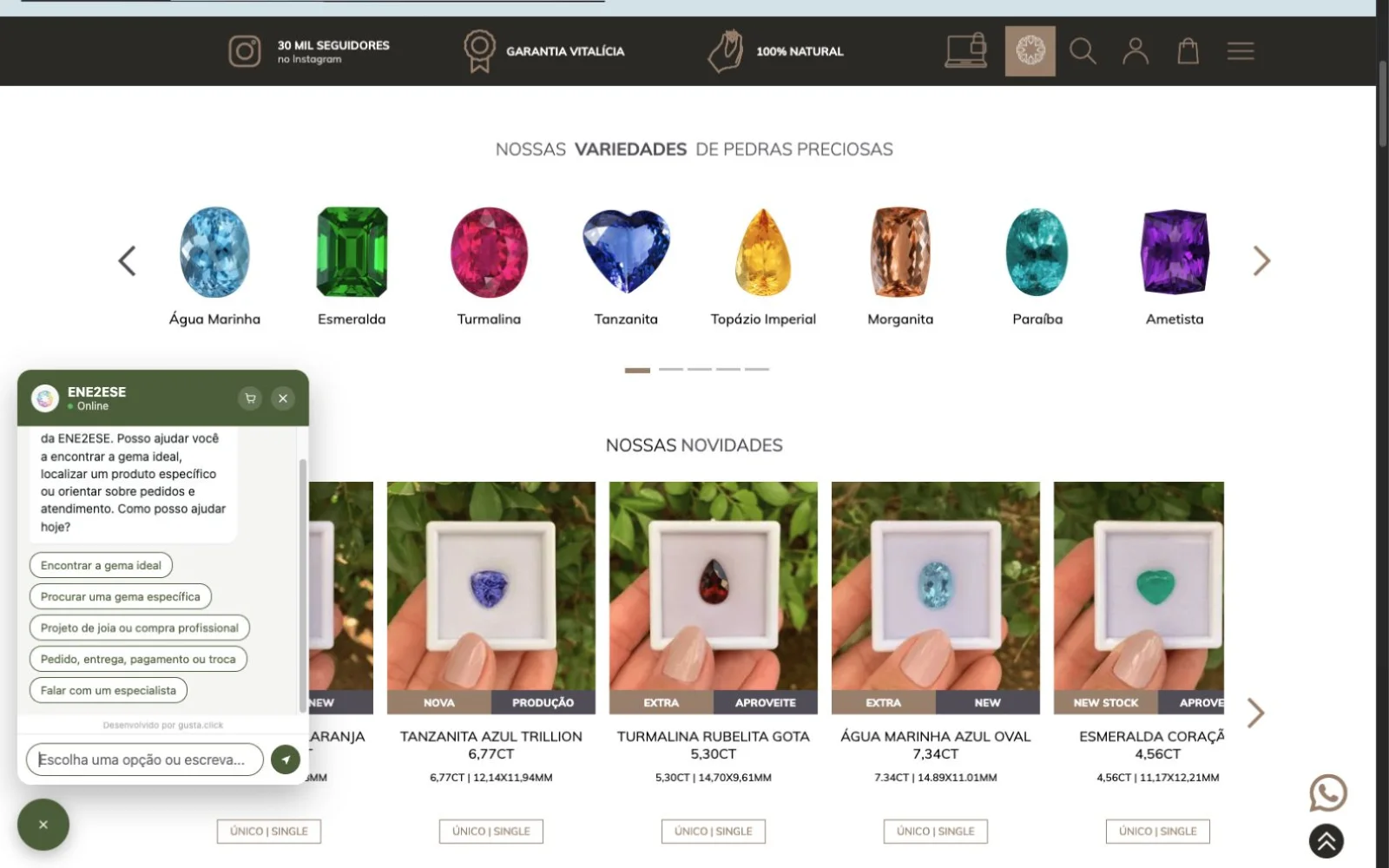
ENE2ESE, a gemstone store on VTEX, has ongoing support from GUSTA and a chatbot that helps customers find their way through the catalog.
What it costs
It depends on the platform, catalog size, integrations and what moves over from the current store. I won't guess a number here, because a price without a scope is a guess.
What GUSTA delivers is a proposal split into parts: what you pay once, what you pay every month and what's left out. Our guide to what a business website costs explains that math, and it applies to online stores too.
Get a quote
Tell us what you need. You get an email confirmation right away, and I will get back to you personally.
Frequently asked questions
Can you move my current store to another platform?
Yes. The migration goes into the scope with a URL inventory, redirects and Google follow-up after the switch, so the new store doesn't launch losing traffic.
Which platform do you recommend?
Honestly, it depends: your catalog, order volume, the systems involved and who'll run the store. You get our recommendation in writing after the diagnosis.
Whose name is the store in?
Your company's. The platform account, domain and access stay in the name of whoever owns the store.
Can you integrate it with my ERP?
In most cases yes, when the ERP has an API or an available integration. The diagnosis confirms that before the quote is final.
Do you look after the store after launch?
Yes. Ongoing support covers fixes, adjustments and improvements to the store, as it does today with ENE2ESE.
Other GUSTA services: AI services for business and website design, hosting and maintenance.
Rather talk before sending a message? Book a chat with GUSTA and we'll look at your store together.
Comments
No comments yet. Be the first to comment.